
What Counts as Citation?
Direct rebuttals framed as spontaneous.

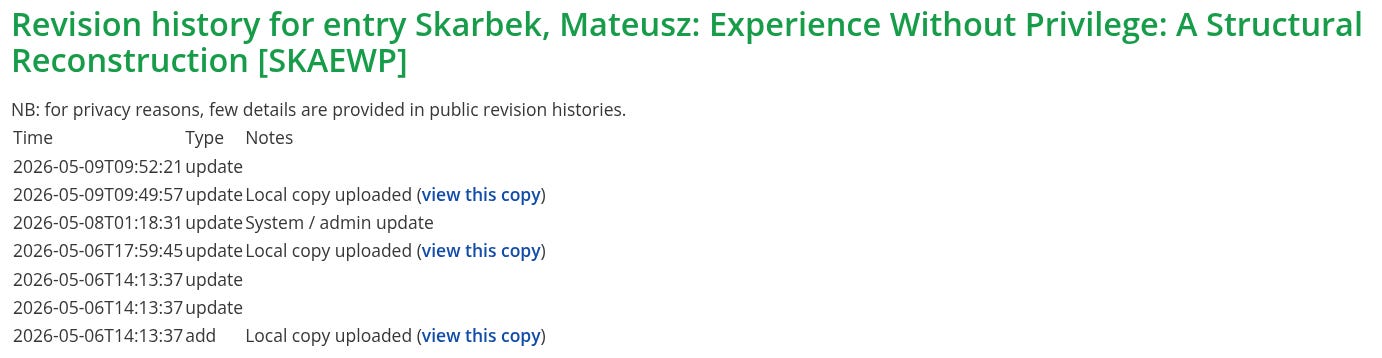
Up front, so it is on the record. While I am the author of this post, the evidence in it was assembled/collated by Claude Opus 4.7 from email exports, copy-pasted PhilPeople comment threads, the PDFs of Skarbek’s published papers, and the prior conversations I have had with Claude about the same person since January. I did not read all eleven of his papers myself. The AI did the close reading and the citation check. The pattern recognition is mine. The legwork that confirmed it is the AI’s. I am being explicit about this because the topic is intellectual provenance, and it would be embarrassing and ironic to fudge mine.
A second caveat. Reconstructing dates and quotes from scraped PhilPapers comments and email notifications is messy. PhilPeople does not give comments stable timestamps in the UI, only relative ones (”a day ago”), so absolute dates have to be triangulated from email subject lines and the “added to PP” stamps on papers. If a date or a quote in this post is off, it is off because of the friction of reconstruction, not because the underlying pattern is in dispute. I will correct anything specific that is wrong. But being real it would also be pedantic, as the over all pattern as usual is my point.
A specific failure mode worth naming. When I paste a comment plus my own contextual notes into the AI, it sees one monolithic block of text. It sometimes loses track of which words were Skarbek’s and which were mine annotating the comment around it. If anything I attribute to him in this post turns out to be a quote from my own surrounding notes that the model collapsed into the comment, that is on me for the input format and on the model for the conflation, not on Skarbek. Same correction policy applies. Tell me which sentence is wrong and I will fix it. Unlike Skarbek, I am acting in 100% good faith, I hope that’s clear and will prove it any time I am able/asked.
How this post happened. Over the past few months Mateusz Skarbek has been responding to my PhilPeople posts. The exchanges escalated steadily. The recent ones have a particular character: long, AI-assisted-feeling (my assertion, can never prove) rebuttals that re-state the same position regardless of how it is answered, and that respond to objections I have not made. After the most recent thread, I clicked over to his PhilPapers page out of pure curiosity. What was the work that EE was threatening hard enough to produce that volume of defense?
I expected to find a body of work that I had been challenging from outside. What I found instead was eleven papers whose titles and AI-written abstracts looked extremely familiar. Like he had been replying to me on his own page in paper form. (Which would be great had he cited me. For a split second I thought he had.)
That should not have come as a shock. PhilPapers has a citation-alert system. If anybody had cited me, I would know. Those would be my first third-party formal citations, which would actually be excellent for me, and I would notice. No alert had ever come. Then I saw the titles. Then I understood why no alert had ever come.
I opened a Claude session and asked it to verify what I was now suspecting. (Obviously AI does what you ask it but I still think all this is fair from evidence, even if I came at it with an agenda.)
What the AI found, in brief, is this. Skarbek’s eleven papers fall into two groups separated by a hard topical break. The first paper, added in late July 2025, is “A Formal Proof of the Structural Impossibility of Communism.” Political economy. Marxist theory. Twenty-five references on central planning, distributed coordination, and post-scarcity labor economics. Topics unrelated to me. Bibliography unrelated to anything I work on.
Every one of his next ten papers is in epistemic foundations, structural impossibility of absolutes, eliminative arguments, burden of proof, qualia and consciousness, modal ethics, or privilege removal. The Susskind-and-central-planning bibliography is gone. A philosophy-of-mind-and-epistemology bibliography (Chalmers, Dennett, Sellars, BonJour, Pryor, Huemer, Hume, Kant, Husserl, Frege, Russell, Wittgenstein, Carnap, Quine, Williamson, Lakatos, Popper, Tarski) appears in its place. This is a categorical pivot, not a drift. None of the ten papers cite me.
The cadence is also worth naming. PhilArchive records the upload date for every paper, and a script using a normal browser User-Agent can pull them all. Sorted chronologically: (If my tech has errors here, please say.)
2025-07-23: Communism paper. Pre-EE territory.
Five-month gap. EE corpus accumulating on PhilPapers throughout.
2025-12-23 through 2025-12-30: Four papers in eight days. Information as a Relational Property, Structural Impossibility of the Absolute, Logic Conditions of Cognition (Beyond Kant), Why Solipsism Cannot Serve as an Epistemic Foundation. The pivot. EE territory. No citation.
2026-01-11: First direct comment to me. Same day, The Problem of Epistemic Bias and What Remains After We Remove Privilege uploaded to PhilArchive. The title paraphrases the EE framing the comment used.
2026-02-05: On the Logical Asymmetry of the Burden of Proof. EE’s central methodological apparatus, reformulated.
2026-02-27 through 2026-04-04: Three more papers, all in EE territory.
2026-04-18 through 2026-05-09: Six revisions to existing papers plus two new uploads (Burden of Proof revision, Experience Without Privilege upload May 6, latest revision today).
The pivot predates first contact. The first paper of the pivot went up December 23, 2025. The first comment to me arrived January 11, 2026. Nineteen days. Skarbek did not start writing in my territory because he met me. He started writing in my territory while my work was already visible on PhilPapers, using my framings without citing me, and then opened the comment thread. Direct engagement did not trigger the pivot. It accelerated and refined an absorption process that was already in motion.
The clearest case is the most recent one. Experience Without Privilege was first uploaded to PhilArchive on May 6, 2026. The latest revision is dated today, May 9, with a PDF generation timestamp of 04:42 AM Central, several hours before the comment thread continued. The paper was being finalized while we were still arguing the rebutted position in PhilPeople comments. The abstract is that position, written up. The introduction maps a lineage: Hume, Sellars, BonJour, Pryor, Huemer. I am the live contemporary articulation of the position the paper is rebutting. I am not in the lineage.
The AI did a full-text search of all eleven PDFs for “sergent,” “innomen,” “brandon,” and “experiential empiricism.” Zero hits in any paper, in any section, body or footnote or references. The contemporary author whose published position multiple papers are explicitly trying to refute is not anywhere in his bibliography.
What I can quote in my own voice, because the email is in my inbox, is the full first comment Skarbek made to me. It arrived as a PhilPeople notification on January 11, 2026:
“I agree that the subtractive move is powerful, and I think you’re right that something like this should have appeared much earlier in the history of thought. In that sense, it strongly echoes Hume’s strategy, though expressed in a contemporary vocabulary. Where I part ways is at the point where the subject is allowed to remain as the final container of what survives the subtraction. That move reintroduces epistemic privilege at exactly the moment when the burden-of-proof strategy should be carried through consistently. My own view is that what survives radical subtraction is not experience as such, but action and its traces, relations that remain assessable independently of any privileged standpoint. Experience may be a special case of that, but it cannot serve as the epistemic ground without reinstating the very asymmetry the method set out to remove.”
Look at the terms. "Subtractive move" is mine, I have a paper titled The Temporal Assumption: Why All Previous Empiricisms Failed to Complete the Subtractive Move. The rest is standard philosophy vocabulary (burden of proof, epistemic privilege, asymmetry) applied directly to my argument as I had stated it. He is not citing antecedents in this comment. He is engaging my specific formulation, using one of my distinctive coinages and standard tools to do so.
He called the move powerful. He conceded the point that nobody before me had made it. He framed my version as a “contemporary vocabulary” for a move with antecedents that did not complete it.
Then he wrote papers on adjacent moves and cited the antecedents, not me. The “action and its traces” alternative he sketched in that opening paragraph is now the subject of multiple papers on his PhilPapers page, including Experience Without Privilege.
There is also the matter of what he is actually rebutting. Skarbek's papers and his comments share a single recurring mischaracterization. He frames my premise as "all access is experiential, therefore experiential reality is ontologically fundamental," which would be a non-sequitur, and which is not what I argue. My premise is that all possible data is experience. Ontology is inferred from there, not asserted, and burden of proof is then applied to the inference. Mind-independent matter does not survive that step. The non-sequitur he keeps catching is in his model of my position, not in mine. Several of his papers aim at a position I have explicitly distinguished EE from in earlier work.
The current thread, ongoing as of this writing, contains another acknowledgment delivered as a sneer. After three thousand words of disagreement he wrote: “this now looks less like a disagreement and more like you skipped Philosophy 101 and jumped straight into a Theory of Everything. I’m not even joking — every couple of months someone shows up with a ‘final framework’ built on exactly this kind of conflation.” Dismissive, but the framing is “Theory of Everything” and “final framework.” That is a category-level recognition.
I am not claiming Skarbek copied my sentences. I am not claiming any specific argument of his is mine. I am claiming that someone who has been in continuous comment-thread engagement with me for four months, who used my terminology in his opening line, who acknowledged the move as novel, and who has written ten consecutive papers in the territory I publish in, with zero citations to me across the entire visible corpus, owes a citation.
Academia has a few names for the behavior: citation suppression, citation amnesia, adversarial omission, erasure. None of them are famous enough to deter it. The standard violated is simple. You cite the contemporary articulation of the position your paper is refuting, especially when you have been corresponding with its author. Plagiarism is a stronger and stricter charge than what I am making, and the bar for it is high. The bar for “publishing in your interlocutor’s territory without naming them” is low. He is well under it.
A note on the AI question, since it cuts to the heart of this. Both Skarbek and I use AI. We agree that using AI is fine. The disagreement is about what counts as using it well. When I challenge his replies as AI-mediated rather than thought-through, the specific charge is what I have called “defend me squire” prompting: pasting your interlocutor’s argument into the model and asking it to defend your prior position, instead of asking the model to test whether your position survives. He has not denied this, across multiple threads. The threads are still up. Anyone can read them.
His PhilPeople bio is one tip of that iceberg: “Independent researcher working on the development of logical algorithms for artificial intelligence. My core focus is formal coherence — I explore logical consistency across disciplines, testing whether ideas hold under structured reasoning. I bring the rigor of logic into philosophy, science, and emerging AI cognition.” Em dash. AI register. None of his eleven papers are about AI, “logical algorithms,” or “AI cognition.” The bio frames the EE-territory pivot as the natural output of an AI-rigor research program, retroactively. The same em-dash signature appears in the subtitle of his February 2026 paper. The point is not that he uses AI. The point is that the use is not pointed at testing his arguments. It is pointed at generating more of them, and the output gets submitted as both comments and papers without a citation back to the interlocutor whose work is being rebutted.
This is part of a broader pattern, and the Skarbek case is one variant of it. EE has been inspiring responses for almost a year and the responses do not converge. Each one picks a different evasion mode.
There is the Journal of Consciousness Studies rejecting consciousness-centered epistemology from me as “too much philosophy” and later publishing Galen Strawson on a partial version of the same move. That is the institutional variant.
There is Oudam Em and the Dimensional Rendering Theory thread, where I documented what looked like extensive structural appropriation. DRT mapped onto EE while inserting a “dimensionless substrate” that violated EE’s foundational logic and let the framework keep its externalism. That is the substrate-shift variant.
There is Nino Kadic, a professional philosopher who engaged at length, never identified a flaw, and made the on-record admission that the existing objections do not imply EE is wrong. Then deleted the debate thread and ran the PhilPapers report button on me hard enough that PhilPapers removed my paper. The censorship was the point. That is the report-and-erase variant.
There is Maggie Vale, who pivoted between equivocation, Popperian objections, and Kafka-trap framings, then blocked and deleted. That is the snark-then-erase variant.
And there is Skarbek. Engage informally. Publish formally, in your interlocutor’s territory using your interlocutor’s vocabulary. Never close the loop with a citation. That is the AI-refactor variant.
The variants do not converge on a flaw. If EE had one, this would be the most efficient mechanism for surfacing it. Instead each respondent picks a different defense move and the moves do not agree with each other. None of the responses identifies the same fatal error. Few even claim a fatal error. They mostly find a way to keep talking without arriving anywhere.
What is specifically new with Skarbek is that AI refactor makes refute-without-cite cheap. The model rewrites a thread of comments into a paper-shaped argument with a clean philosophical lineage (Hume, Sellars, BonJour) and the live interlocutor falls out of the citation list automatically. The tooling that makes it easier to draft a paper also makes it easier to draft a paper that quietly removes the person whose argument is being rebutted. This post is on Substack rather than PhilPapers comments because past versions of this pattern have ended in deletion when names are mentioned, and Substack is harder to censor.
Some readers will tell me to keep replying in the comments. I have been replying in the comments. The comments are the medium of the absorption. Every reply I write there is material he can incorporate into the next paper. The post breaks that loop because the post has to be cited or refuted in a venue with names attached.
If Skarbek wants to disagree with this characterization in a venue with his name on it, citing the work he has been arguing with for four months, I will read it. If he can locate a logical error in EE that he has not yet stated, I will engage it. He has been asked for one repeatedly. He has not produced one.
I am posting this because I want my citation. Eleven months of comment engagement produced no citation and no real progress.
For readers who want to check the work, my PhilPapers page is at https://philpapers.org/s/Brandon%20Sergent and the relevant papers are:
The Three-Step Argument: Why Mind-Independent Matter Violates Burden of Proof
https://philpapers.org/rec/SERTTA-2
Materialism as an Undeclared Religion: The Unmet Burden of Proof
https://philpapers.org/rec/SERMAA-2
The Temporal Assumption: Why All Previous Empiricisms Failed to Complete the Subtractive Move
https://philpapers.org/rec/SERTTA-3
Experientia Est: Name One Thing That Is Not a Subset of Experience
https://philpapers.org/rec/SEREEN
Has Experiential Empiricism Been Done or Refuted? A Systematic Check
https://philpapers.org/rec/SERHEE-2
Skarbek’s PhilPapers page lists his eleven.
I’m considering aiming at his work directly next, and if I do, be assured I’ll cite him, the exact courtesy he has denied me.
Note for the record what was just said in plain text: "Yes, I had no intention of citing you, but since you're practically begging for it, I'll fit you right in with the others in the expanded version of Chapter 11." That is the thesis of the post you are responding to, confirmed in your own words. The standing question was whether you intended to cite the contemporary author whose position your papers target. You have answered. Thank you.
On the non-sequitur charge: the move you keep catching is in your model of EE, not in EE. The premise is "all possible data is experience." The ontology is not asserted by direct inference from that. It is what remains after burden of proof is applied to any further claim. Mind-independent matter is the further claim. It fails BoP.
https://philpapers.org/rec/SERTTA-2 lays out that structure. Argue with that move on its merits if you like, but the version you keep rebutting is the version I have repeatedly distinguished EE from.
Fun aside, EE deletes ontology entirely. Because EE isn't a hypothesis, it's recognition and calculation. https://philpapers.org/rec/SEROWA
You also write that "the burden does not automatically fall where you place it anyway." Your own February 2026 paper, On the Logical Asymmetry of the Burden of Proof, argues that burden of proof follows from a structural feature of implication rather than from convention or placement. The position in the paper and the position in this comment are not compatible. One of them is wrong. Pick.
Job done. Thanks for the citation commitment on Chapter 11. I'm not holding my breath.
Dude. You just admitted that you didn't even read my work but generated some AI slop about it. Stop being ridiculous. It makes no difference to me whether EE works or not. It changes nothing on my end. I interacted with you only because you're spamming links everywhere, so out of intellectual honesty, I checked it out and wrote what I thought. I tried to be polite, so I praised the parts that were good. That's just basic human interaction. Your ego is so inflated that you can't even grasp that.
Of course the corrections improved my work - that’s what corrections are for. Yes, I had no intention of citing you, but since you're practically begging for it, I’ll fit you right in with the others in the expanded version of Chapter 11. As for the logical objections. As you admitted yourself: “all possible data is experience and there is no further data accessible behind it.” And that stronger conclusion does not automatically follow from the weaker premise: “all epistemic access is experiential.” That is the non sequitur I have been pointing to throughout the discussion. So yes - the inability to “point to” something outside experience only gives you the weak claim again. It does not magically generate the strong closure you need to shift the entire burden of proof. The burden does not automatically fall where you place it anyway. You don't even need to write a whole paper to point that. And claiming that I stepped into 'EE territory' is just laughable. Your ego has completely skyrocketed at this point. Maybe read up on the basics, look into the debate on experience, and get a grip. My job is done here.