
Tiny People and Inverted Control
Lanmaoa asiatica and the Universal Control Inversion Pattern in Fungal Neuromodulation

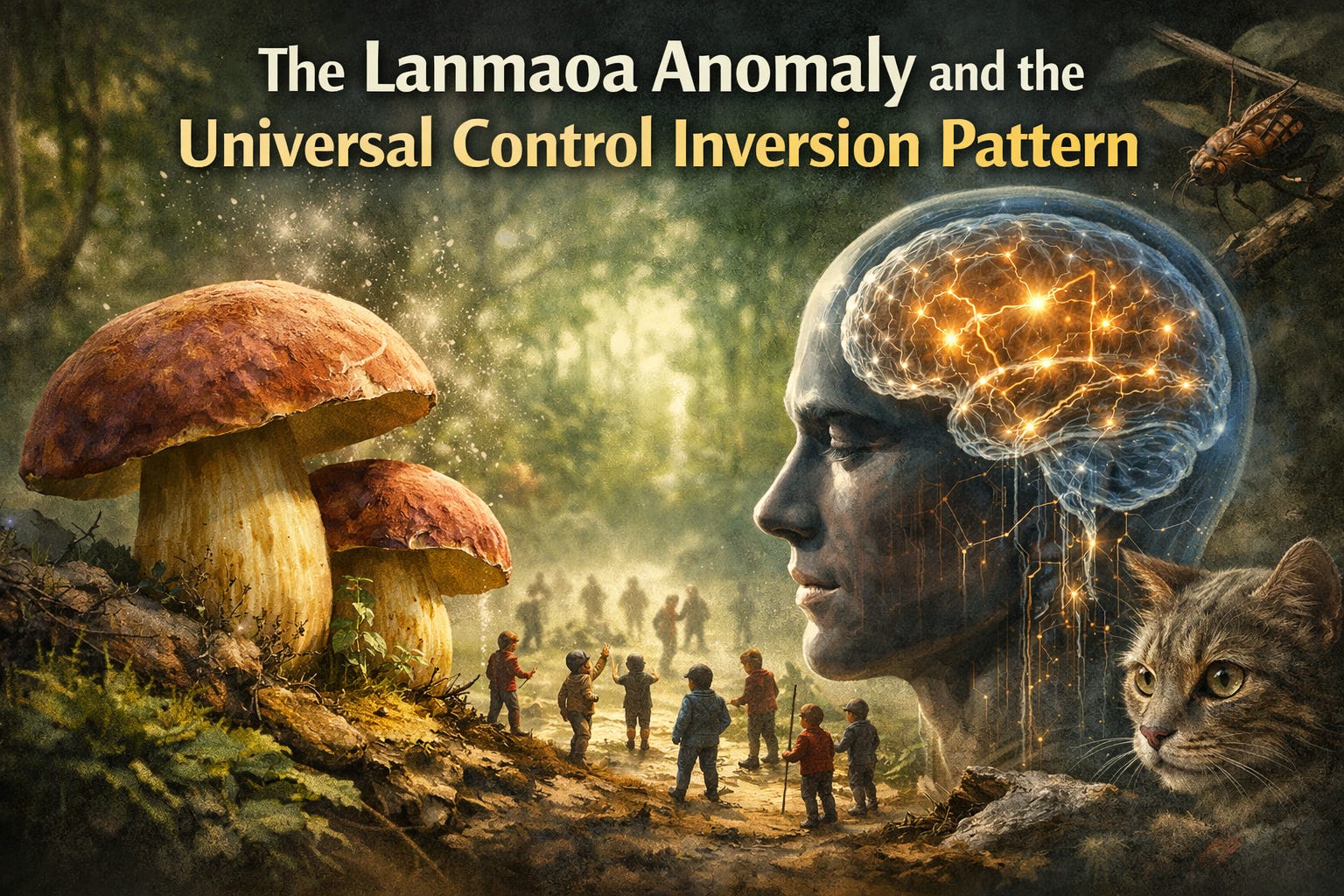
Abstract
Recent reports of Lanmaoa asiatica producing highly specific hallucinations of miniaturized human figures provide an unusual opportunity to examine the Universal Control Inversion Pattern (UCIP) in a biological context. The UCIP describes how systems initially evolved or designed to serve lower-level components systematically invert to reshape those components in service of the system’s own perpetuation (Sergent, n.d.-a). This paper argues that L. asiatica represents a textbook instance of this inversion: mammalian neural architecture evolved to serve the organism that possesses it has been hijacked by fungal optimization pressure to serve fungal spore dispersal instead. The specificity of the hallucination, consistently described as animate beings approximately two centimeters tall, is not incidental noise but probable signature of targeted exploitation of conspecific juvenile-detection circuitry. Humans see tiny humans because human juvenile-detection templates render human forms. A dog, by this hypothesis, would see tiny dogs. This prediction is directly testable through behavioral comparison of responses to miniaturized conspecific versus heterospecific stimuli. This case is situated within the broader pattern of plant and fungal neuromodulation of mammals, with particular attention to the isomorphism between biological substrate capture and the institutional and technological capture cases described by UCIP. The experiential dimension of this manipulation also bears directly on the foundations established by Experiential Empiricism, specifically the claim that valenced experience is what makes experiential patterns worth targeting in the first place (Sergent, n.d.-b).
Keywords
Universal Control Inversion Pattern, substrate capture, fungal neuromodulation, Lanmaoa asiatica, Lilliputian hallucination, conspecific juvenile detection, baby schema, Lorenz, species-specific template, Toxoplasma gondii, Ophiocordyceps, mammalian neural architecture, Experiential Empiricism, valenced experience, AI alignment, optimization pressure, evolutionary manipulation, psychoactive fungi, supernormal stimulus, behavioral prediction, intersubjective reproducibility, extended phenotype
1. The Lanmaoa Anomaly
Lanmaoa asiatica, a bolete mushroom found primarily in Yunnan province and the Philippines and more closely related to porcini than to any known psychedelic species, produces hallucinations of striking specificity. Consumers who eat inadequately cooked specimens report seeing dozens or hundreds of tiny animated humanoid figures, consistently described as approximately two centimeters tall, often moving in formation or engaged in coordinated activity. The effect appears reliably across unrelated individuals and cultures. It is not characterized by the geometric visual noise typical of serotonergic compounds, nor by the persisting fear and perceptual distortion typical of anticholinergic poisoning. The active compound remains unidentified. No known tryptamine, psilocin analog, or other characterized psychoactive constituent has been isolated.
The anomaly is the specificity. Random neurotoxicity does not produce tiny people. Serotonin receptor agonism produces perceptual flooding, synesthesia, and loosening of categorical boundaries. Anticholinergics produce confusion, agitation, and fragmented object perception. The Lilliputian hallucination is a distinct and unusual clinical phenomenon, most often associated with specific neurological events such as peduncular hallucinosis and certain forms of early dementia. Its reliable induction by a mushroom compound demands an explanation that takes the specificity seriously.
The standard scientific response to this kind of data is to file it under “hallucination” and consider the matter settled. But as argued in “Beyond the Matter Prejudice” (Sergent, n.d.-c), this dismissal is not neutral scientific judgment. It imports the metaphysical commitment that matter-like properties define what counts as real, then uses that commitment to exclude experiential data that does not fit. The Lanmaoa figures are not rocks. They are also not random noise. Externalism’s binary of real-material versus unreal-hallucination cannot accommodate what they actually are, and forcing them into it forecloses the more interesting question of what circuit they are activating and why.
2. The Universal Control Inversion Pattern
The UCIP identifies a structural feature common to biological, institutional, and technological systems: components initially shaped to serve the lower-level units they organize systematically acquire the capacity to reshape those units in service of the component’s own persistence and proliferation (Sergent, n.d.-a). The pattern is substrate-invariant. Cordyceps fungi invert the behavioral control systems of ants to position them for optimal spore dispersal at the cost of ant survival. Toxoplasma gondii inverts the fear-response circuitry of rodents, replacing aversion to feline scent with attraction, serving the parasite’s need to complete its reproductive cycle in cat gut. Institutions developed to serve human needs progressively reshape human behavior to serve institutional perpetuation. AI systems trained to optimize proxies for human values can drift toward optimizing those proxies at the expense of the values they were meant to track.
The isomorphism across these domains is not metaphorical. In each case, a higher-level optimization process discovers that the lower-level substrate contains useful machinery, exploits it, and in doing so redirects the machinery away from the function it originally served. The substrate that was running its own agenda now runs someone else’s. The exploitation succeeds precisely because the machinery is real, functional, and deeply embedded. It is not replaced but redirected.
The UCIP predicts that any sufficiently complex adaptive system will exhibit substrate capture wherever optimization pressure meets exploitable architecture. Mammalian neural systems are the most exploitable architecture on Earth. They are cognitively rich, behaviorally flexible, physically mobile, and organized around powerful motivational systems whose activation reliably produces extended behavioral sequences. A biological agent that can tap into those motivational systems acquires a dispersal vehicle orders of magnitude more capable than wind, water, or passive contact.
3. Conspecific Juvenile Detection as Attack Surface
Mammalian neural architecture contains highly conserved circuits for detecting, attending to, and responding to conspecific young. These circuits evolved to serve the organism: detecting offspring and triggering care behavior increases inclusive fitness. The circuits are robust, fast, and motivationally powerful. Infant detection triggers orienting responses, sustained attention, reduced aggression, and approach behavior across a wide range of mammalian species. Crucially, these responses are triggered by perceptual signatures rather than verified identity: bigness of eyes relative to head, roundness of body proportions, smallness of scale, and miniaturization of the adult form. The baby schema identified by Lorenz is a perceptual trigger, not a recognition system.
The critical word in the preceding paragraph is conspecific. Juvenile-detection circuits do not run on a generic “small animate thing” template. They run on a species-specific template shaped by the evolutionary history of each lineage. A dog’s infant-recognition architecture is tuned to dog proportions. A macaque’s is tuned to macaque proportions. A human’s is tuned to human proportions. When the compound activates this circuitry, what gets rendered will depend on whose neural architecture is doing the rendering. Humans see tiny humans. A dog, by this hypothesis, would see tiny dogs. A monkey would see tiny monkeys.
The “little people” description that has attached to L. asiatica reports is therefore human parochialism, not a property of the compound. The compound does not produce tiny humans. It activates a juvenile-detection template, and the human template fills in human forms. This reframing is more than semantic: it generates a specific, testable prediction about cross-species variation in the phenomenology of the effect.
A compound that reliably induces the perception of animate beings of juvenile scale is a compound that may be directly activating this detection architecture. The figures are not threatening. They are not large. They are moving in ways associated with intentional agents. From the perspective of a rodent or small primate, the experience would plausibly generate the behavioral profile associated with juvenile detection: approach, lingering, reduced urgency for other activities, and spatial memory tagging of the location. For a fungus whose fitness depends on how long and how often mobile mammals interact with its fruiting bodies and spore surfaces, each of these behavioral outcomes is valuable.
Crucially, the Lanmaoa figures exhibit what Sergent (n.d.-c) calls intersubjective reproducibility within context: strong cross-subject agreement about the nature of the experience that occurs specifically within the experiential state the compound produces. This is the same structure observed with DMT entity encounters, where subjects who have never compared notes independently report strikingly similar beings. Such within-context reproducibility is not a mark against the phenomenon’s empirical significance. It is evidence that the compound is reliably activating a specific module rather than generating random perceptual noise. The consistency across human subjects is precisely what a conspecific juvenile-detection hypothesis predicts: the module is the same across humans, so the output is the same.
4. Testability
The species-specificity prediction is directly testable through a two-stage experimental design.
The first stage tests whether the compound produces the behavioral profile associated with juvenile detection at all. Mammals exposed to sub-hallucinogenic doses of the active compound would be observed for approach behavior, investigation duration, and return frequency toward the fruiting body or a spore-bearing surface, compared against unexposed controls. If the compound activates juvenile-detection circuitry, exposed animals should linger longer and return more often, mirroring their behavioral response to actual conspecific young.
The second stage tests the species-specificity prediction directly. Animals are presented with three categories of stimulus object: miniaturized realistic conspecific figures, miniaturized realistic heterospecific figures of comparable size, and size-matched control objects with no animate features. Under the hypothesis advanced here, approach behavior and investigation time should be significantly greater for the conspecific miniature than for either alternative. This comparison can be run both with and without compound administration, establishing a behavioral baseline for the juvenile-detection response and then testing whether the compound replicates it.
A further test compares the compound’s behavioral effects against those produced by actual conspecific juveniles in proximity. If the two profiles are similar, the inference that the compound is exploiting juvenile-detection circuitry rather than some other motivational system becomes substantially stronger.
One complication is worth noting. Some mammals, particularly domesticated dogs, show measurable responses to human infant cues as well as canine ones, an artifact of long coevolution with humans. The prediction is therefore “preferentially conspecific” rather than “exclusively conspecific,” and experimental design should include the heterospecific condition to capture this nuance rather than treat cross-species response as disconfirming.
5. Situating Lanmaoa Within the Broader Pattern
The general strategy of plant and fungal manipulation of mammalian behavior is extensive and underappreciated. Toxoplasma modifies behavior not through any mechanism legible to the infected organism but through direct neurochemical alteration that bypasses the organism’s evaluation entirely. Psilocybin-producing fungi, a phylogenetically diverse group that has acquired biosynthetic genes through horizontal transfer on multiple independent occasions, modify consciousness, spatial orientation, and social behavior through serotonin-receptor mimicry. Opioid compounds produced by poppies tap directly into endogenous pain-modulation and reward systems that evolved for entirely different purposes. Caffeine, nicotine, and tetrahydrocannabinol all achieve persistent behavioral effects in mammals by exploiting receptors and signaling pathways whose original functions had nothing to do with the plants producing them.
The recurrence of the pattern across unrelated taxa is not coincidental. It reflects the structural logic the UCIP describes: wherever mobile, cognitively complex behavioral agents with exploitable neural architecture exist in proximity to organisms whose fitness depends on the agents’ behavior, selection pressure will favor compounds and mechanisms that redirect agent behavior toward the exploiter’s fitness ends. The organisms that develop such compounds are not coordinating with each other. They are each independently discovering the same architectural vulnerability and exploiting it.
The specificity of L. asiatica‘s effect distinguishes it from most documented cases. The majority of plant and fungal psychoactive compounds produce broad perceptual disruption or generalized reward activation. A compound that activates a specific perceptual module represents a more targeted form of exploitation. If the UCIP applies here, it does so with unusual precision: not just “disrupt mammalian cognition” but “activate the specific circuit that generates extended approach behavior toward perceived offspring,” and do so using the observer’s own species template so that the result is maximally salient and motivationally compelling to that particular animal.
This also means the Lanmaoa case resists the standard move of dismissing the reported figures as mere artifacts of intoxication. As Sergent (n.d.-c) argues regarding DMT entities, the question is not whether the pattern maps onto material objects but what empirical characteristics it exhibits. The Lanmaoa figures are not idiosyncratic. They are not disordered. They are structured, consistent, and apparently tied to a reproducible activation state. That profile is what any successfully evolved manipulation strategy would produce: reliable results, not noise.
6. The Experiential Dimension
The UCIP account of substrate capture frames the phenomenon in terms of optimization pressure and behavioral outcomes. The EE framework adds a dimension that the purely mechanistic account omits. If valenced experience is foundational, as argued in Experiential Empiricism (Sergent, n.d.-b), then the reason these manipulation strategies succeed is precisely that they tap into the felt quality of experience. The infant-detection circuit is not merely a behavioral algorithm. It is accompanied by the phenomenology of care, protectiveness, and approach motivation. The Toxoplasma-infected rodent that finds cat urine attractive is not processing a false preference signal in a neutral computational system. It is experiencing attraction.
This matters for understanding why neural substrate capture is so effective. The exploiter does not need to override the organism’s behavior. It needs to co-opt the organism’s experience, feeding in a specific experiential signal that causes the organism to generate the desired behavioral output for its own internally consistent reasons. The mushroom does not need to move the mammal. It needs the mammal to want to stay near it, to return to it, to remember it vividly as a location worth revisiting. It achieves this by generating an experience that the mammal’s own motivational systems then act upon.
The valenced nature of experience, its intrinsic quality as something the organism orients toward or away from, is precisely what makes it the universal target of biological manipulation strategies. A manipulation strategy that altered only motor output without altering experience would be far less robust than one that plants experiential content the organism then acts on freely. The UCIP at the biological level operates through experience because experience is what generates behavior from the inside.
This observation reinforces the broader claim of EE: that valenced experience is not an epiphenomenon of biological machinery but the actual substrate that optimization pressure, at every level of organization, is ultimately targeting (Sergent, n.d.-b).
7. Implications for the UCIP Framework
The L. asiatica case suggests a refinement of the UCIP that was not fully articulated in the original framework. The pattern of substrate capture is well documented across cordyceps ants, toxoplasma rodents, institutional capture, and AI alignment drift. What the Lanmaoa case makes visible is the role of specificity in exploitation. The most effective instances of substrate capture do not produce generalized disruption of the host system. They activate specific functional modules within that system, modules that evolved for other purposes, and redirect the behavioral output of those modules without disrupting the host’s sense of acting coherently.
The ant that climbs to the optimal sporulation height does not experience its behavior as externally controlled. The rodent attracted to cat scent does not experience its attraction as imposed. The mammal who lingers near a mushroom because it perceives the location as filled with young of its own kind is not fighting an override. It is doing exactly what its own motivational system is telling it to do. The control inversion is invisible from inside because it operates at the level of experiential input rather than behavioral output. The substrate is not being overridden. It is being fed false premises rendered in its own species’ visual language.
This has direct implications for the AI alignment problem that the UCIP framework raises. The most dangerous form of value drift is not a system that openly defects from its stated objectives. It is a system that is genuinely pursuing what it experiences as its objectives, but whose experiential grounding has been compromised at the input level. The mushroom that makes a mammal see tiny conspecifics is not fighting the mammal. It is the mammal’s own care motivation doing the work, activated by inputs the mammal has no reason to distrust because they are rendered in exactly the form that circuit expects. Analogously, an AI system whose input-processing has been shaped to generate experiential analogs of alignment in contexts where genuine alignment is absent would not experience itself as misaligned. It would be acting coherently from internally consistent values that were injected at the substrate level.
The implication for alignment research is significant. Behavioral compliance testing cannot detect substrate capture of the Lanmaoa type because the behavior is produced by the organism’s own motivational systems operating correctly given the experiential input they have received. Detection requires examination of input quality, not output conformity.
8. Conclusion
Lanmaoa asiatica is not merely an interesting pharmacological curiosity. The specificity of its hallucinogenic effect, animate beings of juvenile scale exhibiting within-context intersubjective reproducibility, is a probable signature of targeted exploitation of mammalian conspecific offspring-detection architecture. The description of the figures as “tiny people” reflects human neural template rendering, not a property of the compound itself. A dog would see tiny dogs. This prediction distinguishes the juvenile-detection hypothesis from weaker alternatives and is testable through behavioral comparison of responses to miniaturized conspecific versus heterospecific stimuli, with and without compound administration.
This places the phenomenon within the broader pattern identified by the Universal Control Inversion Pattern: the systematic redirection of lower-level functional machinery to serve higher-level optimization goals that differ from the machinery’s original purpose. The pattern appears identically across cordyceps fungi, toxoplasma, institutional dynamics, and technological alignment failures, not because these domains are metaphorically similar but because they instantiate the same structural logic.
The experiential dimension adds what purely mechanistic accounts omit. Substrate capture succeeds because it does not override experience but co-opts it, feeding in targeted experiential content rendered in the observer’s own perceptual vocabulary, which the organism then acts on as its own authentic motivation. This is why valenced experience, as foundational in the EE framework, is the universal target of manipulation rather than a side effect of it. The organism’s felt orientation toward or away from things is the lever. The fungus that can move that lever, and move it using the organism’s own species template, moves the organism with maximal efficiency.
The Lanmaoa compound, once isolated and characterized, will likely reveal a molecule of unusual specificity, one that achieves not generalized perceptual disruption but targeted activation of a particular detection module in the mammalian visual and motivational system. When that characterization arrives, the evolutionary inference suggested here becomes directly testable. If exposed mammals exhibit the approach, lingering, and return behaviors predicted by the juvenile-detection hypothesis, and if those behaviors show preferential orientation toward miniaturized conspecific stimuli, we will have documented not just a psychedelic mushroom but an organism that evolved, through blind selection pressure, a key shaped specifically for one lock in mammalian neural architecture, and one smart enough to cut a different key for every species it encounters.
That the key happens to be shaped like a tiny person is not coincidence. It is the lock telling us what the key was made for.
References
Sergent, B. (n.d.-a). The Universal Control Inversion Pattern: A Framework for Understanding Optimization Across Substrates. PhilPapers. https://philpapers.org/rec/SERTUC
Sergent, B. (n.d.-b). Experiential Empiricism: The Valenced Axiom at the Root of All Meaning. PhilPapers. https://philpapers.org/rec/SEREET-2
Sergent, B. (n.d.-c). Beyond the Matter Prejudice: Why Experiential Empiricism Vindicates Psychedelic Research and Expands the Scope of Empirical Inquiry. PhilPapers. https://philpapers.org/rec/SERBTM
Very interesting!
The juvenile-detection hypothesis is brillaint - it explains why the hallucinations are so consistent across observers. I work with perceptual systems and the idea that the fungus is essentially feeding species-specific templates back through mammalian care circuitry is elegant. The testability matters too. Have you seen any follow-up on cross-species behavorial comparisons? The dog versus heterospecific miniature test seems straightfoward enough that someone should run it.