
The Harvest
We should stop pretending the deaths surprise us.

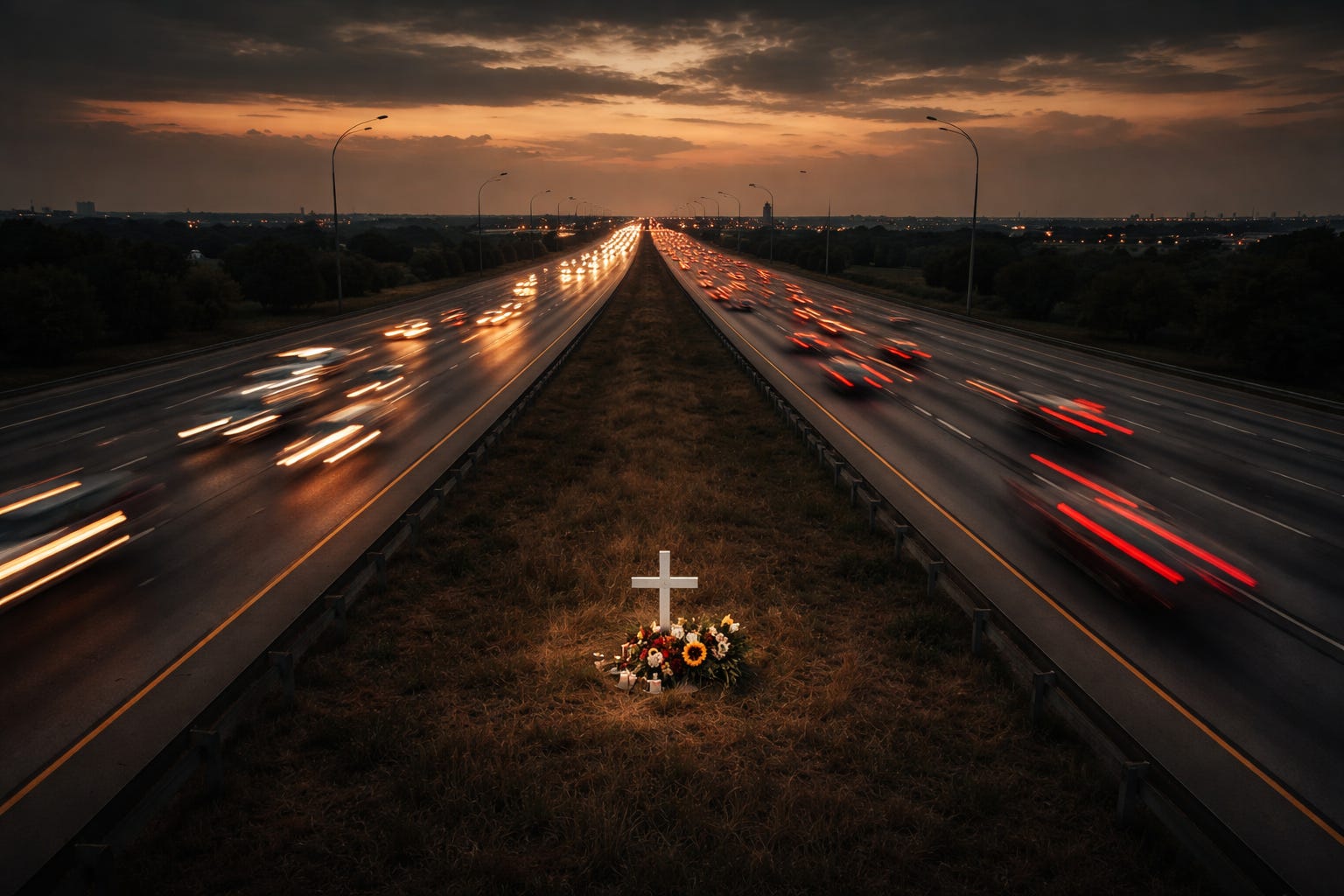
“Raising the speed limit kills people, to save time.” ~Raymond Reddington
San Antonio’s Transportation Department is running a writing contest. Vision Zero SA, their traffic fatality reduction initiative, wanted poems or short essays on the theme “Distractions have no place on our streets.” 300 words max. Times New Roman. A $50 HEB gift card for the winner.
I intend to enter.
Not because I want the gift card, though HEB is awesome. Because the prompt accidentally opened a door they probably did not intend to open, and I am constitutionally incapable of walking past that kind of door.
The stated theme is distracted driving. The unstated assumption baked into that theme is that the problem is the drivers, their phones, their coffee, their wandering attention. The solution implied by that framing is awareness. Education. Personal responsibility. If we just remind people often enough that distraction kills, the killing will slow.
It won’t. And we know it won’t. Because the deaths are not a product of insufficient awareness. They are the predictable output of a system that was designed with a known casualty rate baked in, and then handed a public relations strategy to absorb the moral weight of that rate without triggering any structural change.
We set speed limits high enough to keep traffic moving and commerce humming, knowing full well that higher speeds produce higher fatality rates. We underfund rail. We slow-walk autonomous systems. We run awareness campaigns. And then we are surprised, annually, by the body count we arithmetically guaranteed.
There is a word for knowingly offering a number of lives to preserve an economic arrangement. The word is sacrifice. The only novel thing about our version is that we randomize the selection and call the randomization an accident.
Here is what I submitted:
The Harvest By Brandon Sergent
Each year, roughly 40,000 Americans die in traffic crashes. Distracted driving accounts for over 3,100 of those deaths annually, according to the National Highway Traffic Safety Administration. We are told this is a distraction problem. It is not. It is a policy choice.
Human attention is finite, involuntary, and unreliable. Cognitive science has established this for decades. We are not poorly trained drivers. We are biological organisms being asked to perform a task that requires machine-level consistency. We fail at the rate physics and neurology predict we will fail. The fatalities are not tragedies. They are the expected output of a known system.
The engineering solutions are not mysterious. Dropping urban speed limits to 20 mph reduces pedestrian fatality risk by over 80 percent. Rail infrastructure eliminates the collision variable entirely. Autonomous systems do not check their phones. We have not implemented these things at scale. We have chosen not to. The implicit cost-benefit calculation is that the economic friction of restricting personal vehicle speed and subsidizing alternatives exceeds the acceptable value of the lives lost.
This is the structure of ritual sacrifice. The volcano demands a number. We do not know which individuals will be offered. We know the approximate count. We proceed anyway, and we call it an awareness campaign.
The children killed at crosswalks are not victims of distraction. They are the budgeted cost of keeping commerce mobile and infrastructure investment low. Telling drivers to put their phones down is not a safety policy. It is a way of assigning individual moral blame for a structurally guaranteed outcome, so that the structure itself never has to be examined.
If we are moving, we should stay focused. Mostly, though, we should stop pretending the deaths surprise us.
278 words. Fits their parameters. No foul language. Correct grammar and punctuation.
I don’t expect to win. The contest is run by the same institution whose assumptions the entry is designed to collapse. But the rules said opinion pieces were welcome if you explained what brought you to your conclusion, and I did that, and every statistic in it is real, and the argument holds.
If it places, that will be funny. If it doesn’t, it still needed to be written.
Entries close April 3rd. If you want to submit your own, the prompt is open to the public. https://saspeakup.com/WritingChallenge
Great piece! Well done. I'll be very interested to find out how your letter is received by the sponsoring entity.
Now that you've brought up the subject, I have to speak a peace here.
Like everybody else who has driven shite-tons of miles in their lifetime, I've watched thousands and thousands of people driving on highways and streets over the years, and have always wondered why -- of all things -- the single most dangerous and most common tactic on the roads is something cops practically never give tickets for.
The thing I've noticed is that the greatest cause of accidents BY FAR isn't speed per se, but the idiocy of pretending that no one will ever stop or slow down unexpectedly. I.e., the practice of TAILGATING. Following too closely the car ahead of you.
It seems like more than 50% of drivers have such an itch for velocity that they will instinctively push and creep forward and follow so closely that when a sudden slow-down arrives, they have absolutely no time to respond. (Especially if they were checking their texts at that unexpected moment, but even if they were paying full attention.)
Drivers do this on city streets which is bad enough, but the worst place to do it is on highways, at highway speeds, and an enormous number of drivers do this all the god damned time, as a matter of common, everday course. The massive risk they run for effectively zero benefit is dumbfounding.
I can see two rationales behind this:
Rationale #1: "If the traffic around me is limiting me to 75 miles an hour, I'll get to my destination faster if I stay three feet from the guy in front of me instead of 30 feet. (He's right! He'll get to his destination faster -- by approximate 1.5 seconds. But of course, he pays for that irresistible sliver of advantage by spending every minute of his entire trip running an extra 700% risk of dying and killing others in a violent accident.)
Rationale #2: "If I get on that guy's bumper [at 80 miles an hour, mind you], he'll be intimidated into going faster or getting out of my way. ... I'll keep my brights on too, by the way."
TL;DR:
In my opinion, reasonable speeds (even high speeds in proper contexts) have an exceedingly tiny margin of danger EXCEPT in the presence of the exceedingly common and absolutely idiotic practice of riding on top of the vehicles ahead of you. (This concept has some application laterally too, as in the case of weaving through traffic like a madman, cutting people off, etc.)
I'm reasonably 100% certain I'm right about this, and I don't understand why police don't focus on THIS more than mere speed.
Love your entry!
I suspect if you put it to a vote, a majority of regular old people would vote not to do what, as you spell out, needs to be done. So I don't think it's just transportation officials. Us regular old people don't want nanny governments telling us to slow down. If I had to vote, I'd vote for a slowdown (plus I spent many hours, with the help of some others, going door to door all along my 3 mile street getting enough signatures for the city to install speed bumps - and it has really slowed traffic down) and the other things you suggest. But in other ways, I want my convenience just like everyone else, even at a cost. Humans! We are not a very responsible lot.