
Philosopher Zero
Or the first Sourcerer.


To my knowledge I am still the sole carrier of a whole new idea that amounts to the source code of reality, (Yes, really, try me.) and a burden of proof rejection of material realism and all forms of externalism.
https://philpapers.org/rec/SERTTA-2
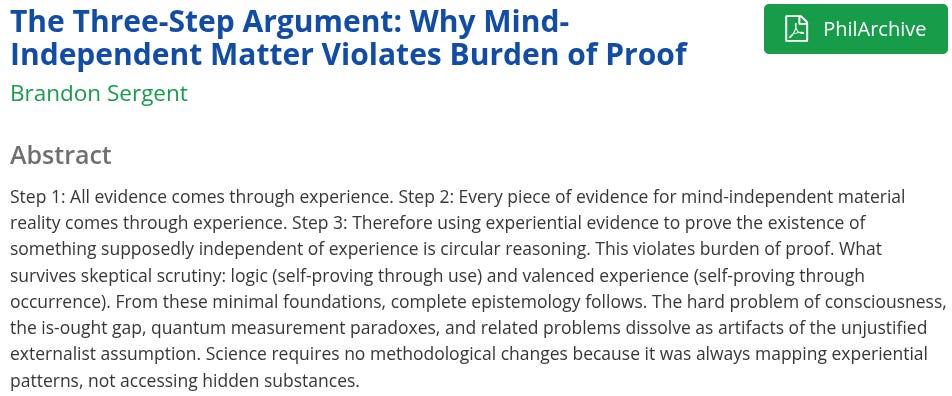
If anyone seeing this can understand it, separate from agree with or internalize it, please let me know.
https://philpapers.org/rec/SERTTT
Also please help me share it for proper study. I tried the peer review system, and they among other things, embraced naked circularity and threatened to sue me.
https://philpapers.org/rec/SERIBH
No one to date has satisfied me that they understand it or offered a cogent meaningful rebuttal on a factual impersonal basis.
What am I talking about? Ask any AI about Brandon Sergent’s Experiential Empiricism, aim it at google scholar if you must help it unearth me. You don’t need me to explain personally, the AI can tell you how my framework would respond, though I am happy to try.
https://philpapers.org/rec/SEREEN
Spacetime Is Religion

I don’t need anyone to read all my work or any of it like it’s a chore. I appreciate the time you spend. EE is dead simple at root. Present experience is the ground floor, the container for everything the way people intuitively think time and space are. But

Born Yesterday

Update: Formalized this a bit and designed an experiment to test it. I am carrying an example of Epistemic Dark Matter.
Done Watering It

I had the AI scrape/compile my EE debates as best it could and caught at least 41 exchanges. (Certainly an under count, see below.) Not a single instance of understanding, let alone agreement or internalization. People understand it well enough to roughly aim counter arguments but mostly those feel like unconscious strawmen or mistaken assumptions, fals…
In the beginning...
Update Edit: So apparently this idea was worthy of publishing. https://philpapers.org/rec/LEECMT-2 (Someone else’s peer reviewed paper basically saying the same thing. Mine was a year before his. And I’m sure totally obvious millennia ago, for whatever That’s worth...)
Brave AI gave me a nice clear explanation but this final paragraph confused me a bit:
Transmission Failure:
Sergent suggests that despite the logical simplicity of EE’s arguments, they fail to spread because integrating the framework requires traversing a "gap" where individuals must inhabit the conclusion that personal identity and external time are present-experiential structures rather than continuous external realities.
I had a look at your SERTTA-2 paper and it's fairly easy to follow and quite logical.
However (there's always a however lol): for fear of bringing up the ghost of Wittgenstein et al., perhaps one problem here is that your 'step 1' is not in fact step 1. The reason is because you haven't adequately defined your two terms 'evidence' and 'experience'.
That's to say, by not deconstructing that word 'experience', you open your thesis up to lengthy counterargument, most of which will - ironically - focus on the definitions of 'evidence' and 'experience'. In particular, it may be the logical case that when we perform that deconstruction we realise that according to your (language game) use of those two terms, what you mean by 'evidence' and 'experience' is in fact exactly the same definition. In which case, you are effectively creating a circular argument, or a logical equation which essentially states A = B, where A and B are in fact the same thing and should result in the reworked equation A = A (or B = B). Actually, better would be 'E = E'.
The definition of 'Experience', for example. Yours appears to have the built-in definition 'everything is experience' (or experiential'). See, that's also an example of A = A (E = E). The denial of something outside of 'Experience = Everything' is built in to the definition.
Likewise, your definition of 'evidence' is built in to the Step 1 assumption 'E = E'. Your step 1, in other words, is not a logical step, it's a definition of terms. And those initial/starting terms thus, logically, define where you end up as a conclusion. In the same way that any computer model will only produce the result determined by the starting parameters programmed into the model.
Your Step 2, by this deconstructive analysis, is simply a re-stating of Step 1. 'Every piece of evidence for mind-independent material reality comes through experience. ' This is exactly the same equation as 'E = E' (or A = A or whatever). It is simply a different linguistic formulation.
You then jump to Step 3, which is the logical conclusion from your previous definition. Thus, by definition (i.e. the initial parameters) you have made it impossible to arrive at any different conclusion. Thus, it's circular reasoning.
We can possibly test this by imagining a definition of one or both of your two terms which does not result in our equation 'E = E'.
Possible option: two people on opposite sides of the world carry out an experiment at the same time, then only later do they share their results. It should be logically clear that 'at the time the experiment/evidence was carried out/obtained' person A has no 'experience' of person B - in other words, Experiment A has no 'experience' (experiential link) of experience B. Put differently 'Evidence A' is unconnected with (i.e. independent of) 'Evidence B'.
The link - i.e. the 'connection' between 'evidence' and 'experience' only happens after the 'evidence' and the 'experience' have occurred. Thus, at the time of the simultaneous equations, from a relative perspective E(A) does not equal E(B) in terms of our Evidence = Experience equation. The only way you could possibly equate E(A) with E(B) is retrospectively, and that - some might say - is what's known in philosophy as 'cheating' (lol).
Anyway - those are some thoughts from - ironically - an old philosophy student who utterly hated analytical philosophy! But I did, at least, pay attention when my lecturers were talking about deconstruction of definitions, and how most definitions as used in philosophy can indeed be deconstructed, and the act of deconstruction often reveals the axiom 'the predicate is in the subject'. That's to say, in a logical statement like 'A = B', when you deconstruct 'A' you realise that it already contains 'B', and is thus circular reasoning (cheating, some might say!).
Of course, if you have addressed this issue in a later paper, give me the link!