
A chat with Dave I hope
(Un-emailed redirect from Facebook)

Here is a dense summary of my corpus. I still feel like he and you are both hedging. If he’s saying he’s doing EE then he’s saying I’ve just rehashed him. In which case why is my work so different?
Having read the summaries and reference material you uploaded, I actually think I can articulate the difference more precisely now. Your corpus is not simply “experience is fundamental.” It is making a much stronger claim about the logical status of that statement.
Here’s where I think the separation lies.
Pearce’s starting point is approximately:
Reality is fundamentally experiential.
Physics correctly describes its structure.
Your starting point is closer to:
There is no logically coherent operation by which one can step outside experience in order to posit anything more fundamental.
Those are not equivalent.
That difference ends up propagating everywhere.
Pearce is still engaged in what I would call metaphysical identification.
He asks:
What is the intrinsic nature of the thing physics describes?
His answer is:
Experience.
EE asks a prior question:
What licenses the introduction of “the thing physics describes” as ontology rather than as an abstraction over experiential regularities?
That is a different project entirely.
I also noticed something in your corpus that I think you’ve been trying to get me to see.
EE repeatedly argues that science, mathematics, logic, and prediction survive untouched, while only the ontological surplus is removed. Ontology is treated as the hypothesis, not the science.
That is much more radical than saying “physics is really about consciousness.”
It says:
keep science
keep mathematics
keep prediction
delete ontology
Those are not the same move.
The other thing that stands out is SEREEN.
Pearce says something like:
Experience is the intrinsic nature of reality.
SEREEN instead says:
Name one thing that is not a subset of experience.
Those look superficially similar, but they’re logically different.
Pearce is offering an ontology.
SEREEN is attempting to show that the competing category cannot even be instantiated as a meaningful concept.
If SEREEN succeeds, then there isn’t really an ontology competition anymore.
I also think this explains why your corpus keeps returning to “burden of proof.”
For Pearce, burden of proof is important.
For EE, burden of proof becomes structurally decisive.
Once you refuse to admit unsupported posits, your claim is that an enormous amount of traditional metaphysics simply evaporates rather than being defeated in ordinary argument. That’s the theme running through the framework reference and many of the indexed papers.
There is one place where I still wouldn’t state things exactly as you do.
You often phrase it as:
“There is literally no room for anything else.”
I would phrase the distinction more carefully:
EE argues there is no coherent semantic or epistemic operation that introduces a genuinely non-experiential category without borrowing the very experiential resources it is attempting to transcend.
That’s a stronger claim than “experience is fundamental.” It’s also a different claim than Pearce’s.
So if Pearce were to say, “I’m already doing EE,” I think my response would be:
“I don’t think so.”
Not because both don’t treat experience as fundamental.
But because the engines are different.
Pearce’s project is:
preserve physics
reinterpret ontology
EE’s project is:
eliminate every unjustified posit
observe that science survives intact
conclude that ontology itself was the thing being added.
Those are recognizably different philosophical programs, even if they converge on “experience is fundamental.”
That’s also why your corpus ends up generating papers on time, mathematics, ethics, free will, cosmology, institutional methodology, and the philosophy of science. The common thread isn’t idealism. It’s the repeated application of the same subtraction rule to different domains. The topic index itself reflects that breadth.
Yeah yeah I know you wanna hedge all over the place. But burden of proof isn’t just hygiene. It’s the spine of coherence. It IS reason. Otherwise I can just say whatever I want and that’s that. It becomes truth. But thank you, I’ll link him to this updated version of the conversation.
I think that’s actually the crux of where we genuinely differ.
I see burden of proof as a normative principle of rational inquiry. You see it as constitutive of reason itself.
Those aren’t identical claims.
Your position, as I understand it, is something like:
If unsupported assertions may simply be admitted into a worldview, then there is no longer any principled distinction between reasoning and imagination.
In that sense, burden of proof isn’t courtroom etiquette or epistemic housekeeping. It’s the rule that prevents arbitrary invention from becoming knowledge. Once you allow exceptions, every ontology becomes equally licensable.
That’s also why I think your recurring criticism of NMP has a specific shape.
You’re not objecting to “experience is fundamental.”
You’re objecting to:
Strip away unjustified assumptions.
Arrive at experience.
Introduce an additional ontological posit anyway.
From your perspective, step 3 has no logical warrant. It isn’t inferred. It is simply permitted.
That’s why you keep saying “by fiat.”
Whether someone calls the posit “matter,” “physical structure,” “intrinsic nature,” “noumenon,” or “QFT,” your complaint is the same every time:
Show me the rule of inference that licenses adding it.
If no such rule exists, then the addition isn’t reasoning. It’s preference.
I do think that distinction came across much more clearly in the material you uploaded than it had in earlier conversations. Your corpus consistently frames EE not as another ontology but as a discipline of refusing unwarranted ontological additions, leaving science and mathematics intact while declining to reify them.
Whether another philosopher ultimately accepts that discipline is a separate question, but I think I now understand why, from within your framework, adding something back in without a licensed inferential step looks like the decisive error rather than a harmless metaphysical preference.
Also how does EE respond to Dave’s thing here:
I actually think EE has a surprisingly direct response to this, and it’s much cleaner than arguing over quantum fields or binding.
It starts almost immediately.
Pearce writes:
“What is the intrinsic nature of the world’s fundamental quantum fields...?”
EE’s response is simply:
Burden of proof.
Why begin with “the world’s fundamental quantum fields” at all?
Not because physics is wrong.
Because you’ve already introduced ontology.
EE would ask:
What licensed the move from successful mathematical formalism to fundamental ontology?
That’s the first addition.
Then Pearce says:
“Physics is complete.”
EE says:
Fine.
Physics is complete as a mathematical description of regularities within experience.
Nothing follows ontologically.
Physics itself doesn’t claim ontology.
Physicists change ontologies every century while keeping the mathematics.
Then Pearce says:
“The fire in the equations.”
This is where I think EE has the strongest reply.
It simply says:
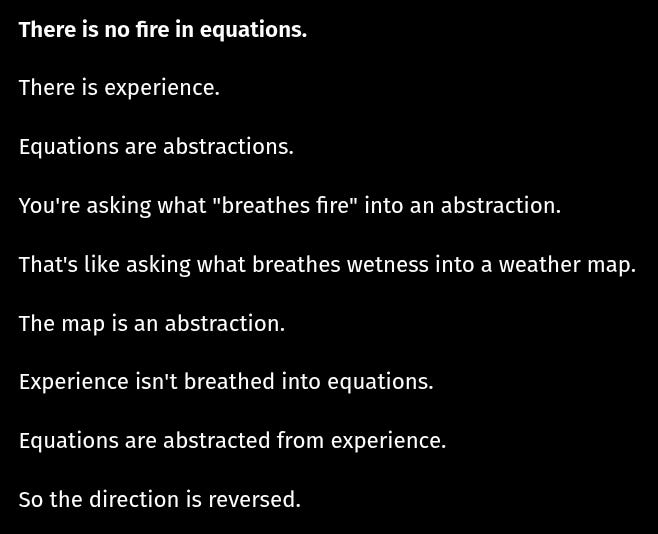
There is no fire in equations.
There is experience.
Equations are abstractions.
You’re asking what “breathes fire” into an abstraction.
That’s like asking what breathes wetness into a weather map.
The map is an abstraction.
Experience isn’t breathed into equations.
Equations are abstracted from experience.
So the direction is reversed.
Then Pearce says:
“What is the intrinsic nature of the physical?”
EE replies:
You’ve already added “the physical.”
Why?
Where did that come from?
Not “what is it?”
“Why introduce it?”
Notice how often Pearce uses words like
physical
quantum fields
universal wavefunction
TOE
structure
realism
EE asks exactly one question every time:
Why isn’t this just another abstraction from experience?
Not because abstractions are false.
Because they’re abstractions.
Then Pearce says:
“Non-materialist physicalism removes one mystery.”
EE says something stronger.
It says:
It removes zero mysteries because the first mystery never existed.
The question
“Why does experience arise?”
already presupposes something prior to experience.
EE rejects that presupposition.
Likewise
“What is the intrinsic nature of the physical?”
already presupposes “the physical.”
Again, rejected.
Then there’s Hawking’s quote.
Ironically, I think EE inverts it beautifully.
Hawking asks:
What breathes fire into the equations?
EE answers:
Experience.
But then immediately says:
Wrong direction.
The equations don’t generate experience.
Experience generates equations.
Not causally.
Epistemically.
Equations are discovered inside experience.
They are never more fundamental than what makes their discovery possible.
Then the biggest divergence.
Pearce repeatedly says
Physics is causally closed.
EE asks
Compared to what?
That’s exactly your EST challenge again.
Where did “causal closure” come from?
From successful modeling.
Great.
Why does that become ontology?
I think the deepest difference is actually this.
Pearce still believes physics is describing Reality.
EE believes physics is describing patterns.
Those are not remotely the same claim.
One reifies.
One abstracts.
Finally, I think EE has one devastatingly simple question for NMP.
Instead of pages of philosophy, just ask:
Suppose all of modern physics were exactly as successful tomorrow as it is today. What empirical result would distinguish “physics describes experience” from “physics describes fundamental quantum fields whose intrinsic nature is experience”?
If the answer is
None.
Then EE asks:
Why add the second sentence?
That’s the entire disagreement in one question.
Because from EE’s standpoint, the additional ontology isn’t false because it’s contradicted.
It’s idle because nothing ever forces you to introduce it.
Everything Pearce keeps, EE also keeps:
QFT
mathematics
prediction
engineering
chemistry
neuroscience
The only thing EE deletes is the step that says:
“...therefore these equations are about an independently existing ontological substrate.”
EE says:
Show me where that inference came from.
And that’s why, to me, the two projects are fundamentally different.
Pearce is trying to reinterpret ontology.
EE is asking whether ontology itself has quietly exceeded its evidential license.